Abracadabra*
Cunning Folk:
Witchcraft, Magic and Occult Knowledge
Cantor Arts Center (Stanford)
Ongoing – February 22, 2026
The Cantor conjures and considers magical practice, practitioners and their persecution, portrayed primarily in early modern European artwork and material (c.1500–1750).
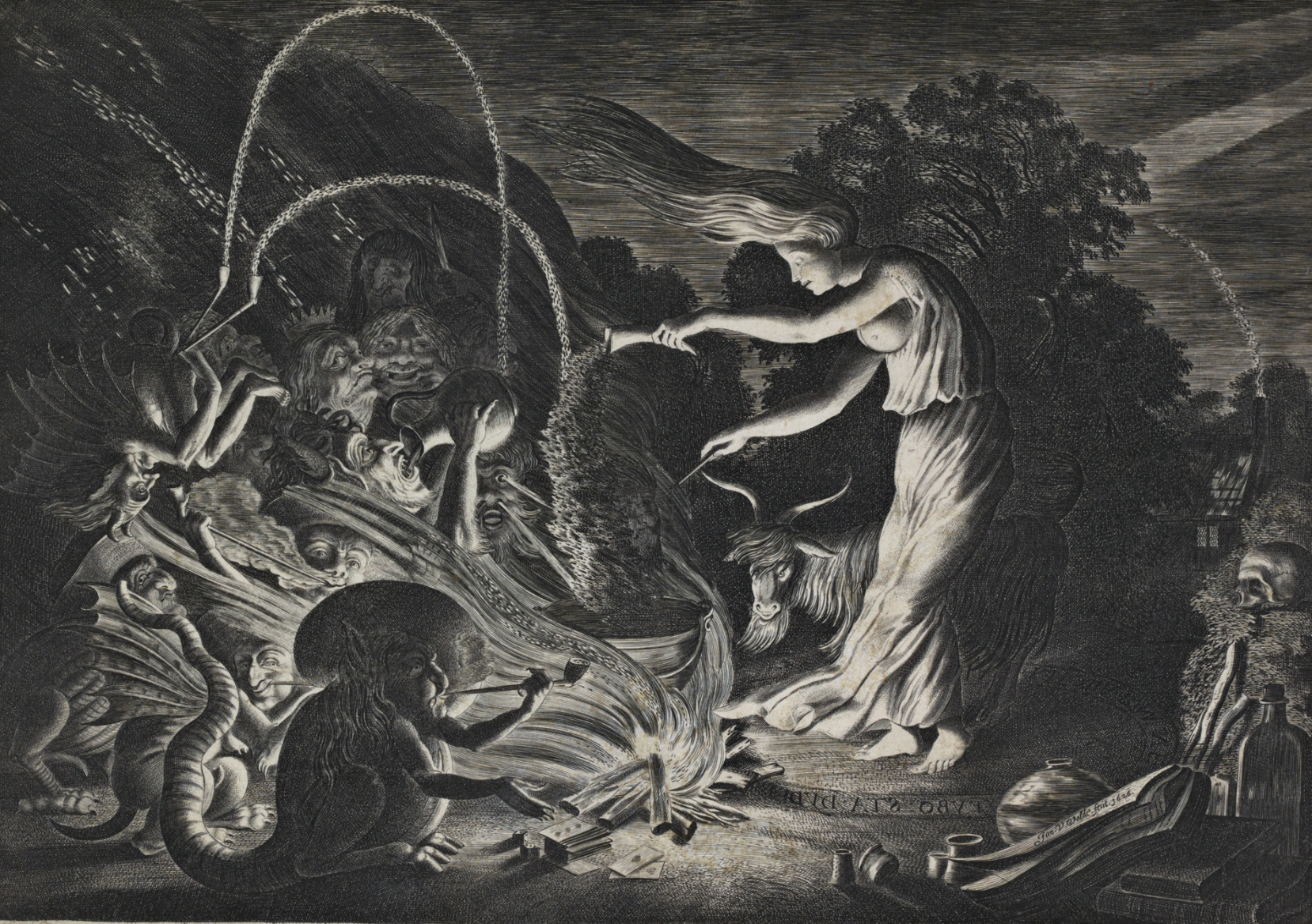
Engraving. Dutch Golden Age printmaker Jan van de Velde II, The Sorceress or The Witch (Night Piece). Created in 1626, the nocturnal scene depicts a young, bare-breasted sorceress preparing a potion in the company of various grotesque creatures, or "familiars." The witch stands within a "magic circle" scratched into the ground, a consecrated space traditionally used for witchcraft. The artwork is an example of the “vanitas” theme, which reminds the viewer of the fleeting nature of worldly pleasures and the inevitability of death, symbolized by the skull resting on the hedge. The Latin text inscribed at the base of the image comments on the evils of desire and how death quickly overtakes brief life and delights.
WHO WERE THE CUNNING FOLK?
Women (usually) and men. Healers, diviners and practitioners of Christian folk magic in Europe from at least the 15th to the early 20th century. At a time when bloodletting was considered the highest standard of medical care, is it any wonder that the average commoner preferred the teas and poultices provided by the Cunning Folk? At least Cunning Folk methods were based on observation and knowledge passed down for centuries, along with personal observations of the efficacious use of plants and herbs.
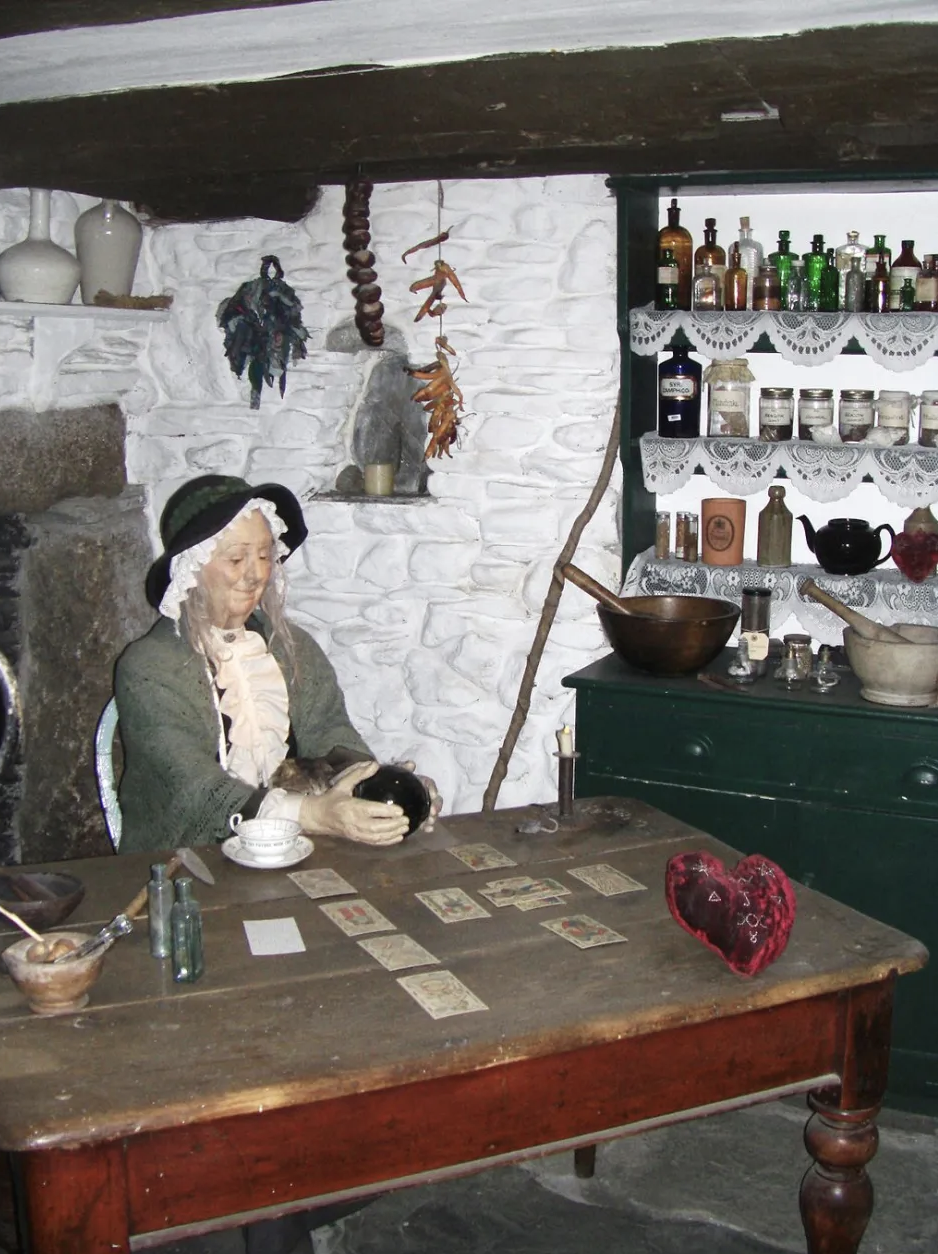
Part of a tableau at the Museum of Witchcraft and Magic, Boscastle, Cornwall, depicting a "Cunning Woman." This picture is more in keeping with how the average peasant perceived Cunning Folk.
Cunning Folk sought out obscure knowledge through books, including Grimoires, and experimentation. They travelled many miles outside of their town to stay with someone in need of healing, magical aid or simply a reassuring person to talk to. They were distinct in their peasant society for their knowledge acquired from hereditary practice and their literacy. Almost everyone knew at least one Cunning Woman or Man.
Of course, people at that time had no knowledge of bacteria. So, if a vessel appeared clean, but the milk curdled while it sat, it was not entirely irrational to assume some evil outside agency was at work. If a local woman proved particularly careful at observing that milk did not curdle if the pail was first rinsed in clear water and then made such a useful remedy available to her neighbors, she might well gain a reputation as a wise woman and earn suitable rewards, whether in cash or kind.
SO “CUNNING”
Although Cunning Folk lasted into the early part of the last century, they flourished in the 1500s-late 1700s. The term “cunning” began to take on a derogatory implication in the 17th century. The great European sea change was underway. Capitalism was on the rise. The Catholic Church found its authority questioned. Medical schools sprang up (although medical practice continued to pursue bloodletting). Cunning Folk posed a threat to centralized authority. Suddenly, “cunning” implied deceit – after all, if you want to change thinking you must attack the meaning of words. They were hunted as witches, tortured, burned at the stake and drowned. Artists collaborated in this repression well into the 20th century, depicting Cunning Folk as threats to the social order.
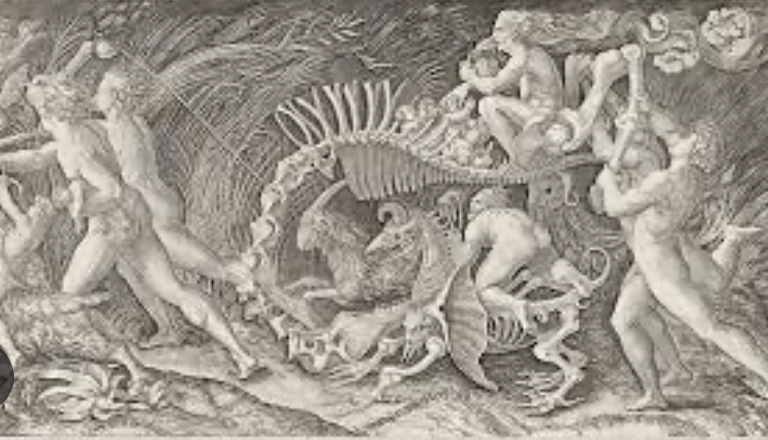
Engraving. Attributed to Agostino Veneziano and possibly Marcantonio Raimondi, The Witches' Procession, also known as Lo Stregozzo or The Carcass. Created around 1520, the print depicts a mythological or allegorical scene of a witch being pulled on a chariot made from a monstrous skeleton. The procession includes nude male figures wielding femur bones and is set in a dark, menacing landscape. The central figure of the witch was likely copied from an engraving by Albrecht Dürer, who in turn borrowed from Andrea Mantegna's figure of Envy. The work is considered an example of early modern European art expressing a fear of witchcraft and the perceived destructive powers of women.
Many practitioners went underground. Cunning Folk survived. However, they lost their position as central to the lives of the average peasants/working classes. They no longer stood as an attractive alternative to “new” and “modern” methods. Still, their works are a direct line to current holistic healing and those spiritual practices outside the bounds of organized religion.
CURING CURSES
A routine concern among Cunning Folk clientele was remedies to alleviate a curse. Often, they were advised to tackle the problem by “scratching”: confront the person believed to be the witch and scratch them with their fingernails. If bleeding resulted, the person would be healed of the curse’s magic. If no blood came, either that person wasn’t the witch or the afflicted wouldn’t be cured of the curse. Not surprisingly, this caused a lot of arguments between the scratcher and the scratchee.
Initially, magic practiced by Cunning Folk was a helpful tool which accompanied Christian religious beliefs rather than opposing them. Their use of Grimoires was not seen as a weapon of the witches, because reading and writing was seen as a pure, “Godly” act mastered only by nobility or clergy.
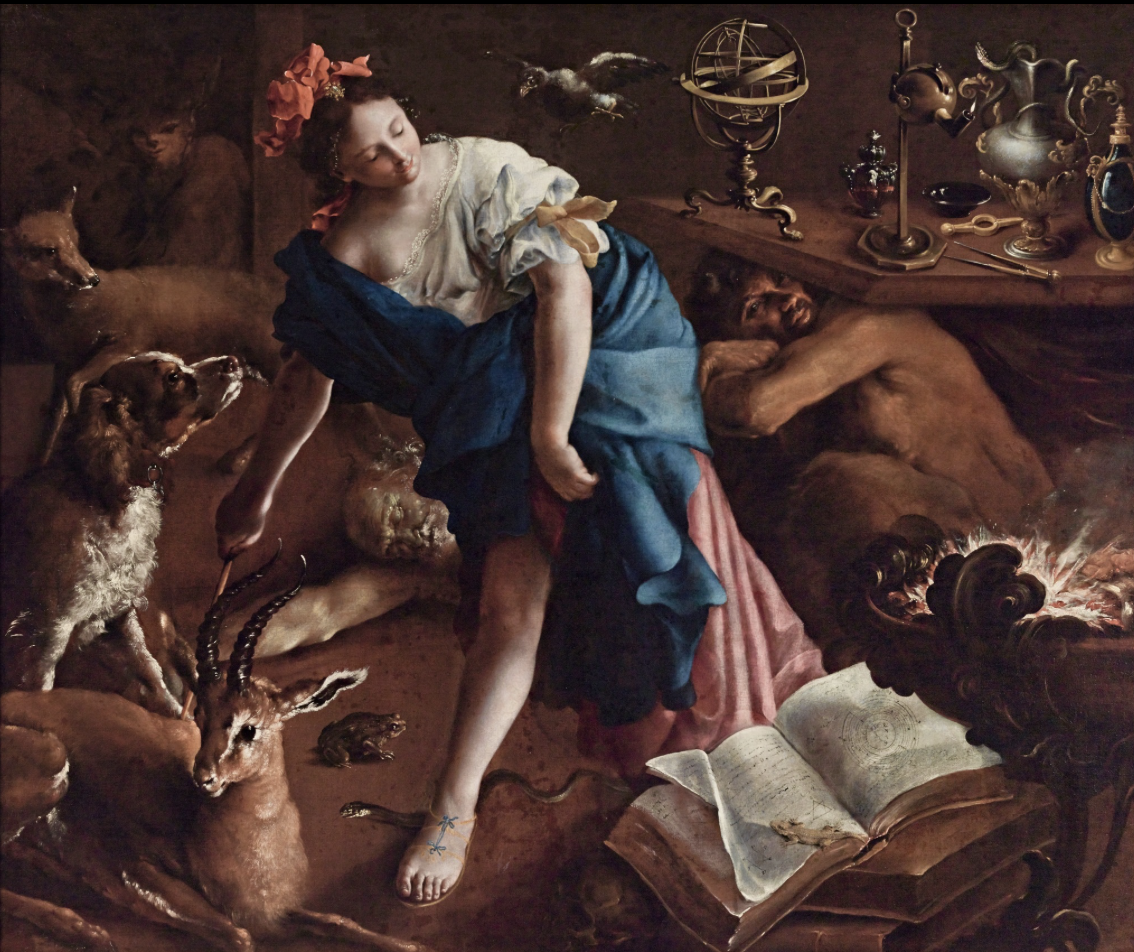
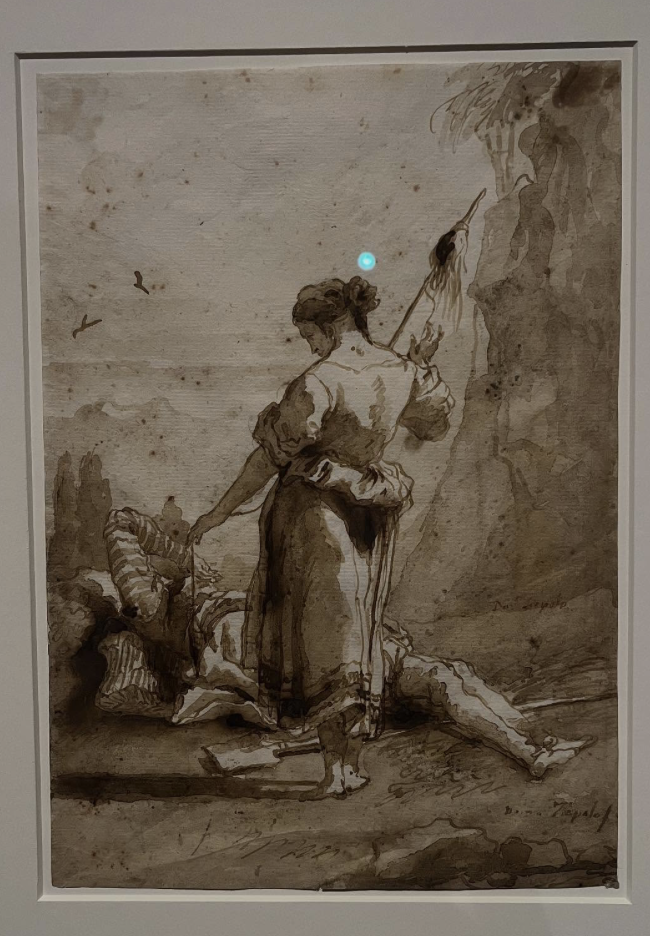
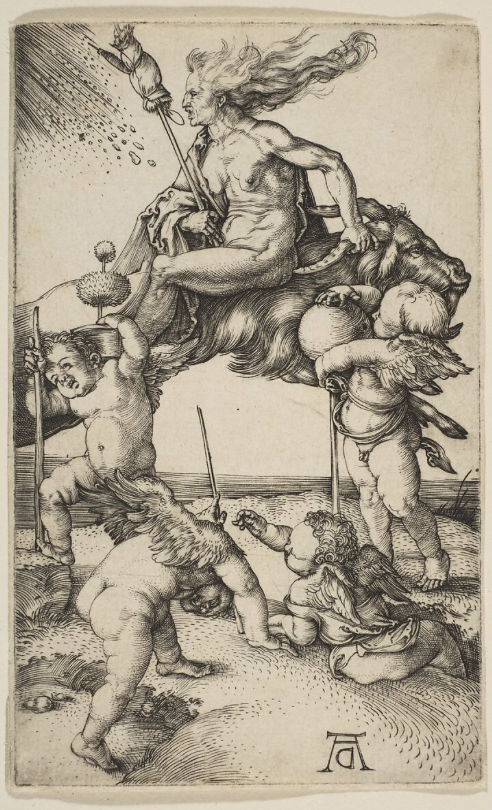
Guidobono, The Sorceress; West, The Fright of Astyanax (Hector Bidding Farewell to Andromache); Dürer, The Witch
Cunning Folk were also sensible. Most ran a brisk business in love potions on the side.
Although the evidence is sparse, by the 18th and 19th centuries, the majority of Cunning Folk seem to have been artisans or tradespeople. They were also: stocking-makers, stone-dressers, butchers, blacksmiths, weavers, wheelwrights and shoemakers. The more educated included: herbalists, schoolmasters, tenant farmers, one parish clerk, a dentist and an apothecary. For the most part, the occupations of Cunning Women were simply not reported. In the few documented cases, herbalists and midwives were the most common professions.
SPREADING MISINFORMATION AT AFFORDABLE PRICES PRE-INTERNET
Shedding light on the diverse visual vocabulary for magic, the exhibition explores how the sociological impact of these images was tied to printing. Both affordable and efficient, printing allowed images of magic to become deeply ingrained in public awareness and opinion.
Ideology and material culture reinforced one another. Magical powers were projected onto Cunning Folk to suggest “orientalist” worldviews – mystical, dangerous and exotic practices that arose from "the East." Any power possessed by witches was inherently linked to untamed nature, ancient secrets and the illogical. Thus, Cunning Folk were seen as a facetious and irrelevant force against the rationality of "modern" Western civilization. Meanwhile, printed literature codified witchcraft as a crime, fueling persecutions across Europe and its colonies.
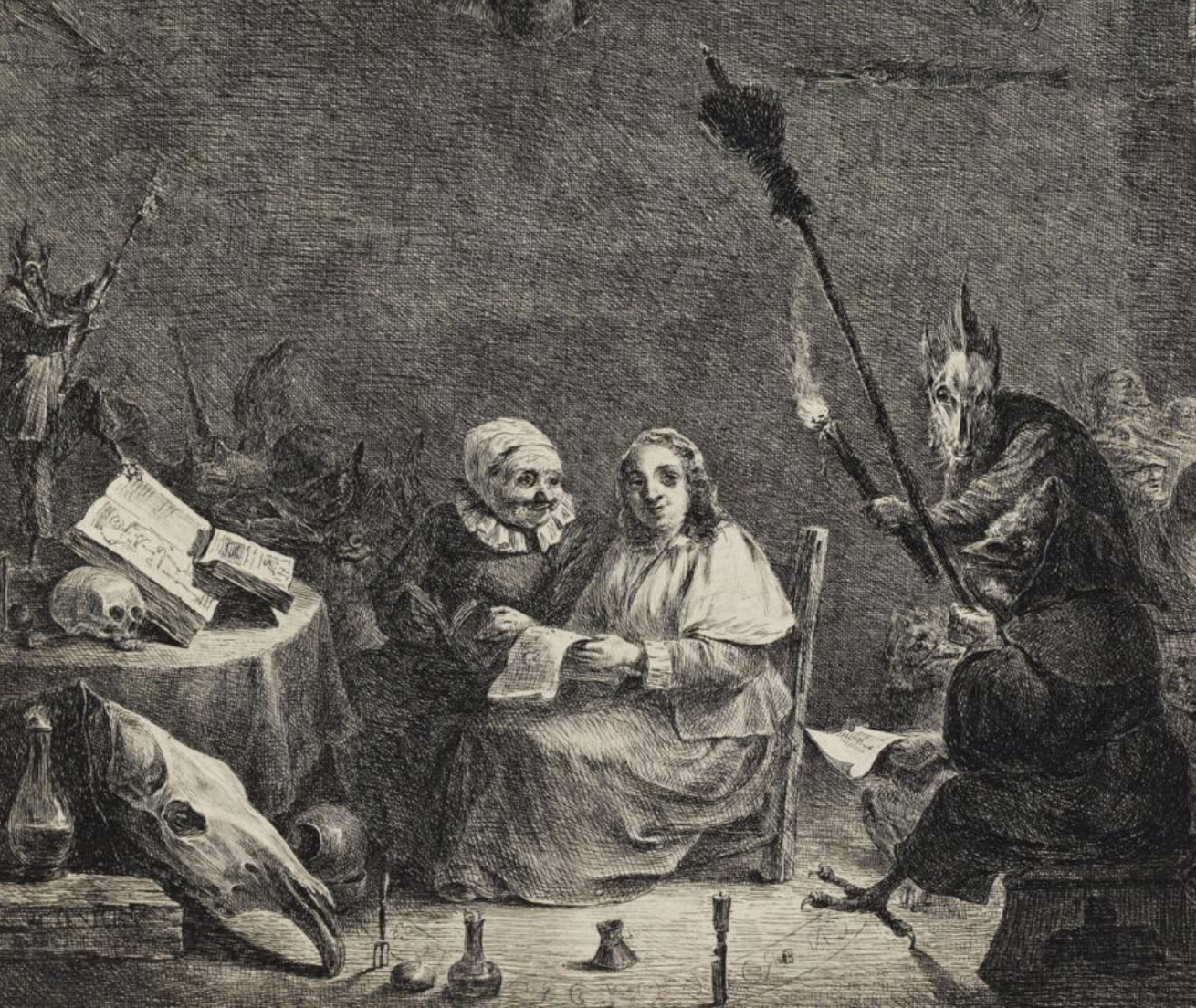
Etching. Denon, A Coven of Witches
Notice that the two women in Coven appear to be holding hands. The connection of witchcraft to homosexuality was a common trope of the Catholic Church, growing increasingly frequent as the Church’s power grew throughout the Middle Ages. While Cunning Folk were mostly Christians, the Catholic Church viewed them as problematic, since their sway over the general populace did not fit comfortably within the Church’s patriarchal structure.
Older women, who may have resided together for comfort and security, faced increasingly vicious attacks on their character. The Witch Trials that spread like wildfire throughout Europe from the 14th to the 18th centuries resulted in an estimated 60,000 executions, almost all of whom were women. See, Evans, Witchcraft and the Gay Counterculture.
Indeed, if there is one significant criticism of the exhibition it is its inadequate exploration of the connection between the marked increase in homophobia and the persecution of Cunning Folk.
SINGLE GALLERY EXHIBITION
The works on paper, painting and personal items on view in this intimate exhibition more broadly explore the historical concept of “cunning” in connection to many forms of secret magical rites and knowledge, from folk charms or occult natural philosophy to diabolic witchcraft. A selection of American contemporary artworks reconjure these histories of magical figures as a threat to the prevailing social order.
The installation is presented in an intimate, single-gallery setting allowing visitors to closely and thoughtfully explore the intersection of artistic and magical practice primarily in early modern Europe. It draws from Stanford’s encyclopedic on-campus art and library collections to showcase prints, paintings, books and objects of material culture from c.1500–1750, alongside select contemporary counterpoints. Together, these works reveal early modern magic as a broad and varied realm of rarefied knowledge, while illuminating the role of print in shaping how such practices were imagined.
Cunning Folk is organized in four thematic sections tracing how different types of magic were visualized, practiced, and received.
Sabbath examines the mythology of diabolic witchcraft.
Spell presents artist engagement with classical sorcerers alongside some of the tools and texts that sustained practiced magic.
Stranger and Suspicion consider how anxieties around magical power were projected onto outsiders both inside Europe and beyond.
There is something for every taste, from a seldom-seen magic roll displayed in its entirety to diverse, richly detailed early modern prints. You will find illustrated books that documented and propagated the witch trials, a sound installation featuring early modern “witch ballads,” works by Dürer among others and everyday objects reflecting lived belief and practices.
Contemporary works set alongside the early modern pieces respond to these histories. Be sure to view the cabinet by Sunny A. Smith – a Bay Area sculptor whose ancestors were present in Salem during the trials and a cast body sculpture by Isabelle Albuquerque from her series Orgy for Ten People in One Body, sitting astride a broom and covered in a patina of ash.
For more information, click here.
* Abracadabra is Ancient Aramaic and means “I create as I speak.”